At BPFIT, one of the things that sets us apart is our in-house programming model. We’ll never outsource this part of what we do because nobody knows our community, our athletes, and our coaching philosophy better than our own team.
We take tremendous pride in continually learning, evolving, and refining our approach to help you get the most out of your training.
Whether you’re preparing for your first HYROX race or chasing a new personal best, we want you to understand how our programming works and, more importantly, how to use it to your advantage.
With multiple class types available throughout the week, you have the flexibility to build a training schedule around your goals. But more options can sometimes mean more questions. How much strength training do you need? How often should you attend BPHYROX? Is one HYROX class enough? And where does BPSTRENGTH fit into the equation?
Let’s break it down.
1. Understanding the BPFIT Weekly Schedule
- Monday — Strength & Conditioning | BPFIT / CrossFit
- Tuesday — Endurance | BPHYROX
- Wednesday — Strength & Conditioning | BPFIT / CrossFit
- Thursday — Endurance | BPHYROX
- Friday — Strength Accessories | BPSTRENGTH
- Saturday at 8 AM — Strength Endurance | BPFIT / CrossFit
- Saturday at 9 AM — Endurance | BPHYROX
Each class serves a purpose. The goal isn’t to attend as many classes as possible. It’s to build a balanced training week that develops the qualities you need to perform well on race day.
For HYROX athletes, that means building strength, improving aerobic capacity, developing running efficiency, and learning to perform when your legs are already fatigued.
2. Strength Is Your Foundation
HYROX is an endurance race, but that doesn’t mean endurance should be your only focus.
Every race includes eight 1 km runs and eight functional workout stations. Those stations demand strength, muscular endurance, and the ability to repeatedly produce force while managing fatigue.
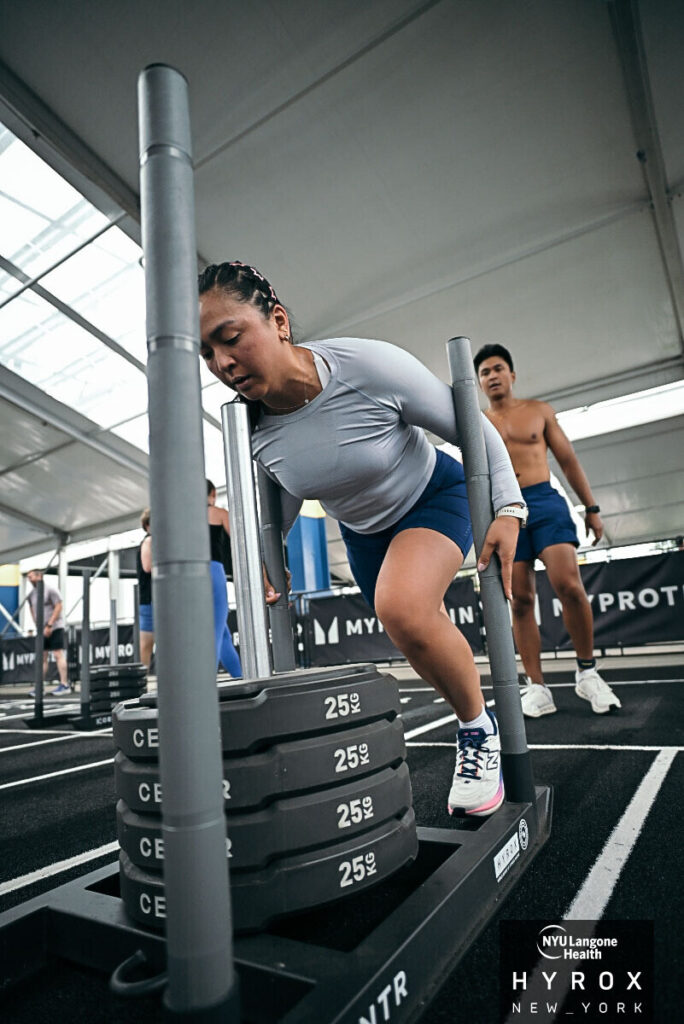
Building a stronger foundation can help you move sleds more efficiently, handle loaded carries, maintain control through lunges, and perform wall balls with less relative effort.
That’s why we encourage HYROX athletes to maintain consistent strength training throughout their preparation.
At BPFIT, you can develop that foundation through:
- BPFIT / CrossFit: Build overall strength, power, and work capacity through varied strength and conditioning sessions.
- BPSTRENGTH: Supplement your training with targeted strength accessories and additional work to address individual needs.
- Strength endurance sessions: Develop the ability to sustain muscular effort while working under fatigue.
You don’t need to become a powerlifter to be a successful HYROX athlete. You do need enough strength to handle the demands of the race without every station becoming a maximum-effort event.
The goal: make the work feel more manageable so you can preserve energy and keep moving.
3. Endurance Is More Than Just Getting Tired
HYROX performance is heavily influenced by your ability to run efficiently and recover while moving from one station to the next.
That’s where BPHYROX comes in.
Our endurance sessions help you develop the aerobic engine needed to sustain effort over the course of a race. Depending on the session, that may mean working on pacing, longer efforts, intervals, or the ability to repeatedly run and work under fatigue.
But there’s an important distinction: being good at working hard isn’t the same as being good at endurance.
Effective endurance training requires more than going all-out every session. It requires developing the ability to maintain a strong, sustainable pace, recover between harder efforts, and manage your energy throughout the race.
For HYROX athletes, this matters because your running performance doesn’t exist in isolation. You’re running after sled pushes, sled pulls, burpee broad jumps, and other demanding stations.
The better you can manage your effort and recover between stations, the better position you’ll be in for the next kilometre.
Our recommendation? Make BPHYROX a consistent part of your weekly routine, and resist the urge to turn every session into a race simulation.
4. Why You Need Both Strength and Endurance
One of the biggest mistakes HYROX athletes can make is focusing exclusively on endurance while neglecting strength, or doing plenty of hard conditioning without developing their aerobic base.
HYROX rewards athletes who can combine both.
Strength training helps improve your ability to produce force and handle demanding stations. Aerobic training helps you sustain work over time and recover between efforts. Higher-intensity conditioning helps you become more comfortable working at challenging efforts.
These qualities overlap, but they aren’t interchangeable. You can’t replace all your strength work with running, and you can’t build your entire race engine through heavy lifting alone.
At BPFIT, you have access to programming that develops these different qualities. The key is putting them together in a way that supports your goals without accumulating more fatigue than you can recover from.
Consistency beats cramming. Four well-planned training sessions each week will generally serve you better than stacking hard sessions every day and showing up exhausted.
5. Building Your Weekly HYROX Training Schedule
Your ideal schedule depends on your training experience, current fitness, recovery, and how close you are to race day. The examples below are starting points, not rigid rules.
HYROX Training: 3 Days Per Week
Three sessions per week can be an effective approach if you’re newer to HYROX, balancing training with a busy schedule, or prioritizing recovery.
Option A: Balanced Strength and Endurance
- Monday: BPFIT
- Tuesday or Thursday: BPHYROX
- Saturday: BPHYROX
Option B: Endurance Priority
- Tuesday: BPHYROX
- Wednesday: BPFIT
- Saturday: BPHYROX
Option C: Strength Priority
- Tuesday: BPHYROX
- Thursday: BPHYROX
- Friday: BPSTRENGTH
Our recommendation: Start with a combination of strength and endurance rather than trying to maximize one at the expense of the other. If you’re choosing Option C, make sure you already have a reasonable strength foundation and consider how much running and conditioning you’re doing outside the gym.
HYROX Training: 4 Days Per Week
Four sessions per week allow you to build a more complete training base while maintaining a manageable schedule.
Option A: Balanced Performance
- Monday: BPFIT
- Tuesday: BPHYROX
- Thursday: BPHYROX
- Friday: BPSTRENGTH
Option B: Strength and Endurance Balance
- Tuesday: BPHYROX
- Wednesday: BPFIT
- Friday: BPSTRENGTH
- Saturday: BPHYROX
Option C: Endurance-Focused
- Tuesday: BPHYROX
- Thursday: BPHYROX
- Friday: BPSTRENGTH
- Saturday: BPHYROX
If your biggest limiter is running or sustaining effort throughout the race, an endurance-focused schedule may make sense. If you’re struggling with sleds, lunges, carries, or maintaining muscular output, prioritize a schedule that consistently includes strength work.
Keep in mind that Friday and Saturday are consecutive training days. If you choose that combination, pay attention to the intensity of each session and make sure you’re recovering well enough to get quality work out of both.
6. A Few Things to Keep in Mind
You don’t need to go all-out every day. Hard training has its place, but every session doesn’t need to leave you exhausted. Train with purpose and learn to distinguish between productive effort and unnecessary fatigue.
Don’t neglect running. HYROX includes eight 1 km runs, making running a major component of your overall race time. BPHYROX is an important part of your preparation, but additional running may be beneficial depending on the class programming and your individual needs.
Train your weaknesses without abandoning your strengths. If you’re a strong athlete who struggles to run, more strength work probably isn’t the answer. If you’re a great runner who gets crushed by the sleds, you may need to invest more time in strength development.
Recovery is part of the program. Sleep, nutrition, hydration, and appropriate rest between demanding sessions all influence your ability to adapt to training. More volume is only beneficial when you can recover from it.
Your training should evolve as race day approaches. General strength and aerobic development are important year-round. As your race gets closer, your preparation may need to become more specific to HYROX pacing, station transitions, and running under fatigue.
7. Let’s Build a Plan That Works for You
At BPFIT, our goal isn’t simply to get you through more workouts. It’s to help you become a stronger, fitter, more capable athlete.
Our programming gives you the tools. Your job is to show up consistently, train with intention, and give yourself enough time to improve.
If you’re preparing for a HYROX race and aren’t sure which classes to prioritize, reach out to our coaching staff. We can help you look at your schedule, identify your biggest opportunities for improvement, and build a weekly routine that fits your goals.
Whether you’re training three days a week or four, racing for the first time or chasing a personal best, the right plan is the one you can execute consistently and recover from.
Let’s build your engine, get stronger, and get ready to race.
Let’s get to work
2-Week Unlimited Trial